

The automotive wiring harness is widely recognized as the “neurological system” of modern New Energy Vehicles (NEVs). As global electrification accelerates, wiring harness engineers and procurement specialists face a crucial selection dilemma: Why are industry standard organizations mandating a comprehensive shift toward Low Smoke Zero Halogen (LSZH) materials, while accelerating the retirement of legacy PVC cables?
Understanding the technical logic behind this material evolution requires analyzing the unique operational environment of high-voltage (HV) electric vehicles and the demanding compliance thresholds required for battery-adjacent components.
1. Why Is the In-Vehicle Environment So Demanding for High-Voltage Cables?
An electric vehicle is not merely a transport medium; it is a highly integrated, enclosed space. High-voltage cables are densely routed inside engine compartments, operating adjacent to battery packs, HV connectors, and sensitive micro-sensing circuits.
Low Tolerances for Thermal Faults
When traditional halogenated (such as PVC) cables experience short circuits or electrical overloads, their primary threat is not merely flammability, but the chemistry of their combustion byproducts.
Preventing Secondary Disasters
In thermal runaway or localized electrical fire events, standard PVC insulation releases high concentrations of dense black smoke alongside toxic, corrosive halogenated gases. Dense smoke severely impedes passenger evacuation and emergency response vision. Simultaneously, acidic gases attack circuit boards and ECU sensors, escalating localized electrical faults into vehicle-wide systems failures.
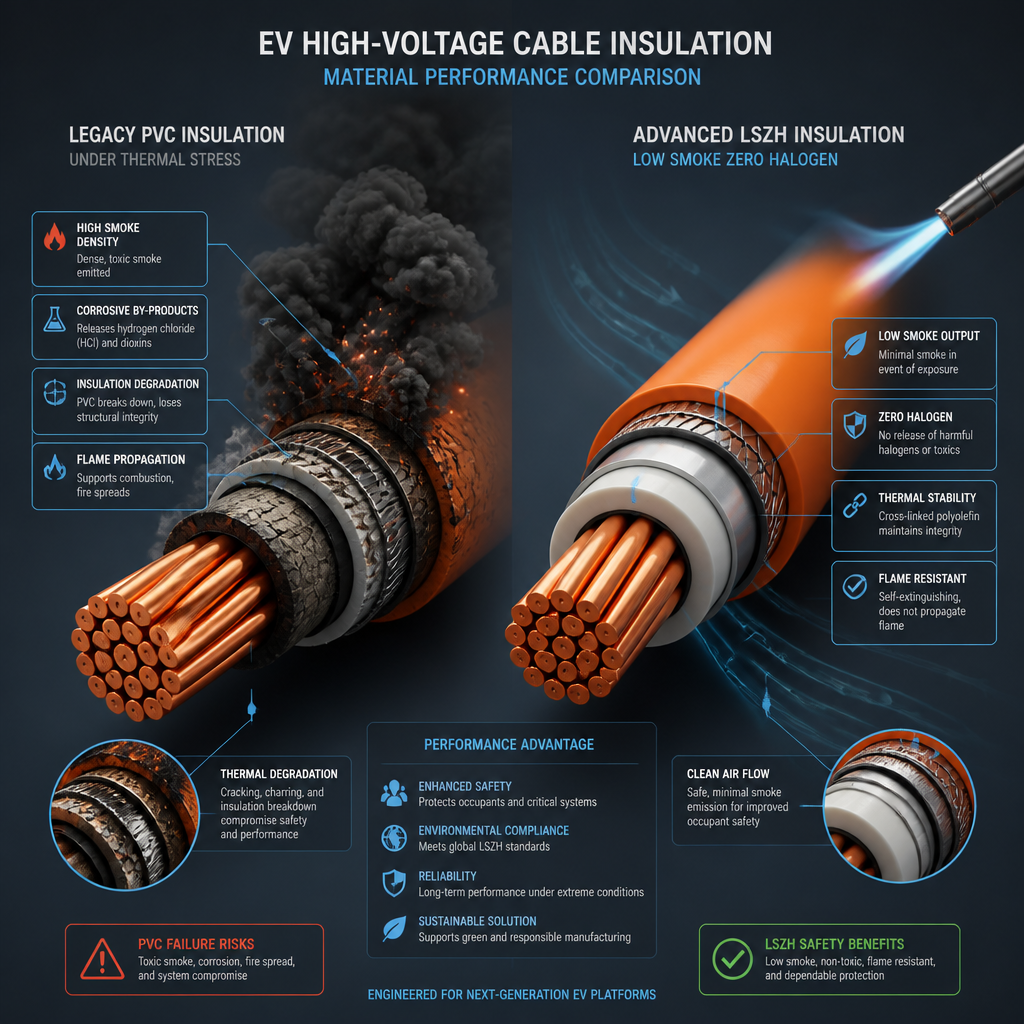
2. Material Performance Comparison: LSZH vs. Halogenated PVC
LSZH insulation compounds offer distinct technical and chemical advantages in high-voltage EV applications. The table below outlines key engineering metrics and their operational impact on vehicle systems:
|
Performance Metric |
Traditional Halogenated Cable (e.g., PVC) |
LSZH Flame-Retardant Cable |
Impact on EV Systems & Safety |
|
Smoke Emission Rate |
High; generates dense black smoke |
Extremely Low; high light transmittance |
Preserves visibility during emergency evacuation and rescue operations. |
|
Toxicity & Corrosivity |
Releases acidic/toxic halogen gases (HCl) |
Zero halogen, non-toxic, non-corrosive |
Prevents chemical degradation of ECU boards and onboard electronics. |
|
Flame Retardancy Rating |
Moderate to Low |
Superior (Meets UL VW-1 / ISO specs) |
Prevents flame propagation along cable paths to the battery pack. |
|
Temperature Tolerance |
Typically limited (-20°C to +105°C) |
Broad range (-40°C to +150°C) |
Withstands continuous thermal dissipation from high-amp charging cycles. |
3. OEM Selection Criteria: Why the VW-1 Flame Test Is Non-Negotiable
When auditing bill-of-materials (BOM) specs for high-voltage cables, the VW-1 (Vertical Flame Test) serves as a non-negotiable benchmark for insulation integrity.
[ Flame Test Specification Benchmark ]
Cable Suspended Vertically ➔ Sustained Direct Flame Ignition ➔ Criteria: Rapid Self-Extinguishing / Zero Dripping Ignition
The VW-1 protocol subjects the cable to extreme conditions: a vertically suspended specimen is exposed to direct, sustained flame burn cycles. To pass, the insulation layer must demonstrate:
- Rapid self-extinguishing capabilitiesimmediately upon flame removal.
- Zero sustained vertical flaming.
- No flaming drips/particlescapable of igniting underlying cotton indicators.
Advanced solutions, such as OMG EV high-voltage cables, achieve compliance with stringent VW-1 standards. This ensures that even under severe operating conditions—such as prolonged solar heat loading, intense mechanical vibration, or continuous electrical overload—the insulation layer retains its structural and mechanical integrity without acting as a thermal fuse or flame pathway.
4. Frequently Asked Questions (FAQ)
Q1: How can harness R&D engineers balance unit material costs against strict flame-retardant requirements?
A: Prioritize sourcing from established suppliers whose cable profiles hold validated VW-1 certifications (e.g., OMG EV Cables). Utilizing unverified or custom-blended low-cost insulation compounds increases long-term risks of material failure, thermal breakdown, and costly field recalls.
Q2: What is the continuous temperature rating for modern LSZH cables?
A: High-grade LSZH materials (particularly Cross-Linked Polyolefin / XLPE) exhibit superior thermal aging resistance. Standard-compliant OMG EV cables maintain continuous operation within a -40°C to +150°C window, easily absorbing the localized thermal spikes generated during fast DC charging and sustained high-voltage discharge cycles.
Conclusion
The shift toward Low Smoke Zero Halogen insulation in high-voltage automotive cables represents a crucial safety imperative for modern EV architecture. Mandating rigorous flame-retardant standards (such as VW-1) at the initial component sourcing phase provides the primary defense layer against secondary thermal hazards in next-generation electric vehicles.
For detailed technical datasheets on ISO-compliant LSZH high-voltage cables, consult authoritative standard databases like UL Standards and ISO Automotive Electrical Standards.