

With the rapid popularization of 800V high-voltage platforms and high-power liquid-cooled ultra-fast charging, the current density and voltage levels of electric vehicle (EV) high-voltage systems continue to surge. There is a common saying in the industry: “You can choose the right connector, but if you choose the wrong cable, the entire system will still fail temperature rise and reliability tests.”
Achieving a “perfect match” between high-voltage (HV) cables and high-voltage connectors is far more than simply ensuring that “terminals can be inserted into the housing and threads can be screwed smoothly”. It is the result of the systematic synergy of electrical, mechanical, environmental, standard compliance, and manufacturing process dimensions. Any single-dimension mismatch can introduce severe risks, including contact resistance heating, liquid ingress, electromagnetic interference (EMI), or catastrophic insulation breakdown.
Below, we will first dissect the “rigid requirements” imposed on cables by connector giants Phoenix Contact and Aptiv, and then analyze how OMG fulfills them dimension by dimension.
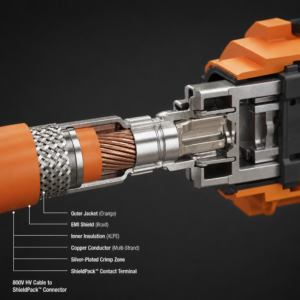
“Rigid Requirements”: What Strict Demands Do Global Connector Giants Place on Cables?
As industry benchmarks in the new energy connection field, Phoenix Contact and Aptiv impose rigorous boundary conditions on their mating cables.
1. Phoenix Contact: The Benchmark in Charging and High-Voltage Connection
In the field of electric vehicle charging, Phoenix Contact provides comprehensive DC charging solutions. Its High Power Charging (HPC) series (such as the EV-T2HPCC-DC500A series) complies with the IEC 62196-3 DC charging standard, supporting high-current DC fast charging. The matching cables must meet:
- High Current-Carrying Capacity and Low-Resistance Design:Specially designed to support ultra-fast charging currents of 500A and above.
- High Temperature-Resistant Insulation and Stable Temperature Rise Performance:Maintaining reliable current transmission capabilities under hot summer ambient temperatures.
- Strict Charging Interface Compliance:Consistent with the IEC 62196 series and the GB/T 20234 charging and swapping standard ecosystem.
2. Aptiv: Systematic Requirements for Automotive-Grade High-Voltage Connection Systems
Aptiv boasts over two decades of mass-production experience in automotive-grade high-voltage connection. Its HVDuty® series (RCS800, RCS1400) and ShieldPack™ high-voltage connectors are widely used in battery packs, DC/DC converters, onboard chargers (OBC), and inverters. Aptiv’s connectors generally impose the following constraints on cables:
- Defined Conductor Cross-Sectional Area Range:Taking the ShieldPack™ HV RCS890 as an example, its high-voltage cable adaptation range covers 16mm²–70mm², while the High-Voltage Interlock (HVIL) loop utilizes 0.35mm²–1mm² fine wires—the cable conductor cross-section must fall within the connector terminal’s adaptation interval.
- High-Voltage Interlock (HVIL) Integration:Connectors safeguard operational safety through the HVIL loop, requiring matching cables to feature a stable interlock signal loop.
- Rigid Environmental Ratings:Universally requiring IP67/IP6K9K protection, vibration resistance, oil and fluid resistance, and a wide operating temperature range.
- Assembly Assurance Mechanisms (CPA/SPA):Several of Aptiv’s connectors feature Connector Position Assurance (CPA) or Terminal Position Assurance (SPA), demanding high stability in cable end-processing dimensions and assembly consistency.
How OMG Cables Meet These Stringent Standards
As a leading R&D manufacturer of new energy cables in China and a drafting unit for multiple national cable standards, OMG has constructed a technology matrix covering EV charging and high-voltage interconnection solutions. Adhering to the matching logic of industry standards, OMG‘s compatibility with world-class connectors is fully reflected in five dimensions:
1. Electrical Matching: Synergy of Current Load, Voltage Withstand, and Insulation
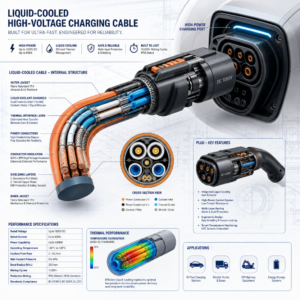
OMG high-voltage cables cover mainstream high-voltage wire standards such as ISO 19642, LV216, UL758, and QC/T 1037, supporting AC 600V/DC 900V and AC 1000V/DC 1500V ratings. Targeting ultra-charging scenarios, OMG provides high current-carrying solutions; its liquid-cooled charging solutions support 320kW–800kW+ rapid energy replenishment, with a continuous current of 600A+ and peak currents reaching 1200A, highly matching the “high current + low contact resistance” capabilities required by Phoenix Contact high-power DC charging and Aptiv high-voltage power connections.
2. Mechanical Matching: Conductor Architecture, Cross-Section, and Crimp Process
- Conductor Structure and Flexibility:Optimized for the routing bends and terminal crimping of automotive high-voltage harnesses, OMG optimizes conductor cross-sectional areas and stranding structures to ensure no wire breakage occurs during crimping.
- Wire Gauge and Terminal Compatibility:Interoperable with Aptiv ShieldPack™ series connector terminal ranges, cooperating with crimping parameters provided by suppliers to ensure pull-off force and contact reliability meet standards. The same crimping and dimensional matching logic applies equally to the termination requirements of Phoenix Contact HPC DC charging connectors.
3. Environmental Reliability: Thermal Performance, Sealing, and Flame Retardancy
Tailored specifically for electric vehicles, OMG high-voltage cables adopt advanced high temperature-resistant insulation materials, robust outer jackets, and low-smoke zero-halogen (LSZH) formulations. They are adaptable to IP67/IP6K9K, oil/fluid resistance, and wide-temperature working environments commonly required by connectors.
4. Standard Compliance: Technical Empowerment by National Standard Drafting Unit
As a primary drafting unit for national standards, OMG possesses profound technical expertise within the GB/T, QC/T, ISO 6722, and IEC 62196/GB/T 20234 frameworks. This ensures that original equipment manufacturers (OEMs) and harness manufacturers can achieve seamless compliance alignment throughout the entire “cable-connector-vehicle” value chain.
5. Process Consistency: Batch Stability and Process Capability
High-voltage harnesses demand “one-in-a-hundred-thousand” reliability. OMG‘s engineering capabilities in batch consistency, process capability index ($C_{pk}$), and product traceability serve as vital guarantees for maintaining the long-term stable performance of high-voltage cables when paired with international brand connectors.
Matching Matrix Table: Phoenix Contact & Aptiv Requirements vs. OMG Cable Solutions
|
Matching Dimension |
Phoenix Contact & Aptiv Requirements |
OMG Cable Solutions |
|
System & Qualifications |
Automotive-grade quality systems and target market product certifications |
IATF 16949, ISO 9001 systems; TUV/UL/CQC/CE and other product certifications |
|
Materials & R&D |
Material safety and reliability |
XLPE/XLPO/TPU/TPE and other material formulations; flexible, high-temperature resistant, oil and acid/alkali resistant |
|
Testing & Inspection |
Electrical performance and reliability verification capabilities |
In-house self-inspection capabilities for voltage withstand, insulation performance, temperature rise, anti-aging, flame retardancy, etc. |
|
Quality & Traceability |
Batch consistency and traceability |
Process consistency, stable and consistent product batches, raw material traceability via MES systems |
|
Co-Development Capability |
Joint matching verification with connector manufacturers |
Extensive experience in joint matching development and verification with internationally renowned connector manufacturers |
Objective Perspective: Four Common Pitfalls Engineers Must Avoid
From an independent engineering perspective, regardless of how strong a cable manufacturer’s capabilities are, the responsibility for system validation still rests with the OEM and Tier-1 integrators. Beware of the following four common design traps:
- Focusing Solely on Rated Voltage While Ignoring Current-Rise Temperature:High-voltage platform voltages are consistent, but if cable resistance is too high, temperature rise under high continuous current can easily trigger local overheating.
- Overlooking Conductor Cross-Section and Terminal Adaptation Ranges:Using conductor sizes that exceed the tolerance range specified by the connector manufacturer will inevitably compromise crimp integrity.
- Skipping Joint Validation Testing:Crimp, thermal cycling, vibration, and environmental sealing must be verified through combined assembly testing rather than relying solely on datasheet values.
- Neglecting Standard Ecosystem Alignment:Cable, connector, and vehicle-grade standards must belong to a unified, coordinated compliance framework to prevent standard conflicts.
Conclusion
In the era of rapid 800V platform deployment and ultra-fast charging network popularization, achieving a “perfect match” between cables and connectors has evolved from a basic component selection task into a mission-critical systems engineering discipline. Represented by OMG, leading Chinese new energy cable enterprises—leveraging rich experience, R&D strength, core patents, and standards-setting qualifications—are gradually becoming trusted partners for international connector giants like Phoenix Contact and Aptiv. For harness and system engineers, choosing a top-tier supplier is merely the starting point; rigorous joint verification remains the ultimate key to translating theoretical compatibility into absolute operational reliability.