

The global transition toward Electric Vehicles (EVs) hinges on one critical factor: charging speed. With High-Power Charging (HPC) networks now delivering 350kW to 500kW of power, EVs can add hundreds of miles of range in under 15 minutes. However, this rapid transfer of energy introduces a massive engineering challenge: extreme thermal generation.
According to Joule’s Law, the heat generated in a conductor is directly proportional to the square of the current I²R. When currents escalate from 150A to over 500A, high-voltage cables experience exponential thermal spikes. Without advanced thermal management, this heat leads to voltage drops, insulation degradation, and catastrophic safety risks.
As a leading innovator in EV conduction technology, OMG High-Voltage Cables has engineered a suite of solutions designed to mitigate extreme heat, ensuring safety, efficiency, and longevity in fast-charging ecosystems.
1. The Physics of Heat Generation in High-Power Charging
To understand how OMG manages thermal loads, we must first examine why high-power charging generates such extreme heat. The cable assembly encounters thermal stress from two main vectors:
- Internal Conductor Resistance (I²R Losses):Even high-purity copper possesses inherent resistance. When pushing high currents during DC fast charging, this resistance converts electrical energy into thermal energy.
- Contact Resistance:The interface where the charging connector meets the vehicle inlet experiences localized heating, which conducts backward into the cable assembly.
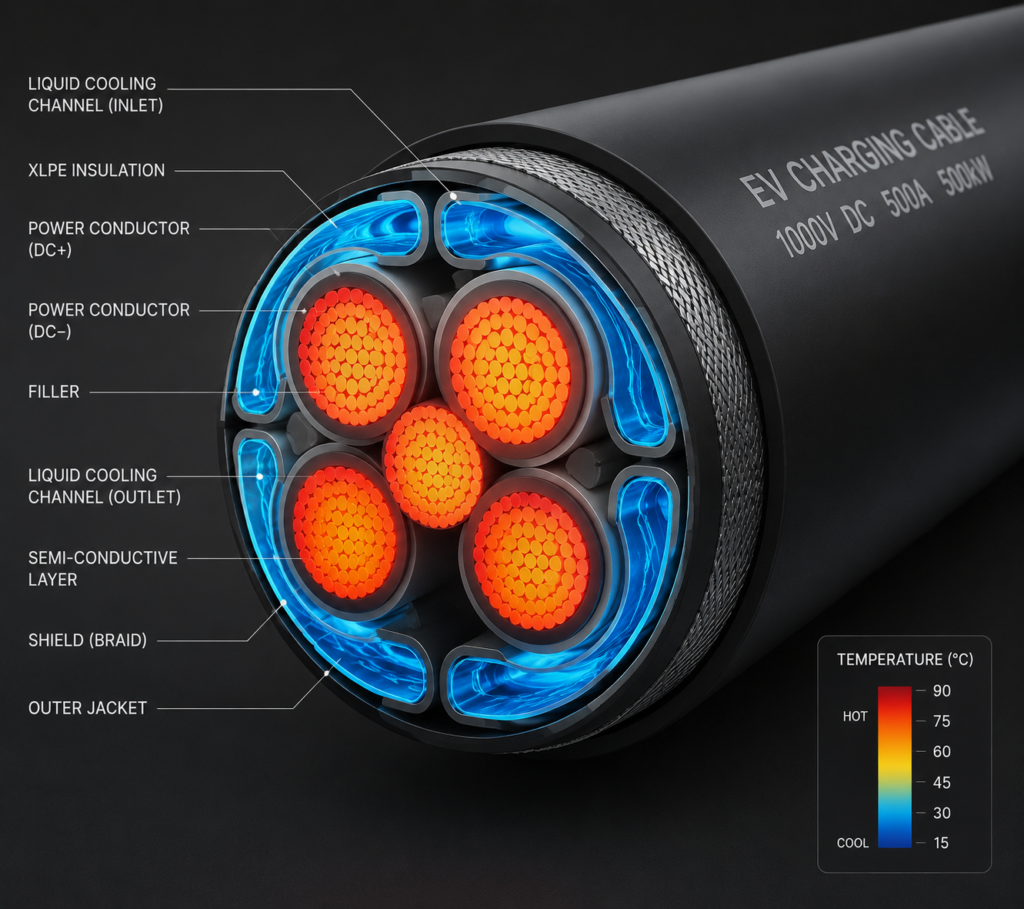
If the cable’s operating temperature exceeds its rated threshold (typically 125℃ to 150℃ for high-spec materials), the consequences are severe:
- Thermal Runaway Risk:Unchecked temperature rises can melt insulation layers.
- Derating Limitations:Vehicle management systems automatically throttle (derate) the charging current if sensors detect overheating, drastically extending charging times and frustrating users.
2. Material Science: OMG’s Advanced Insulation and Jacketing
The first line of defense against thermal degradation is material composition. Standard PVC or basic elastomers fail under the sustained thermal stresses of 500A charging. OMG utilizes proprietary Cross-linked Polyethylene (XLPE) and advanced Thermoplastic Elastomers (TPE/TPU) that have undergone electron-beam (E-beam) cross-linking.
Why Cross-Linking Matters
E-beam cross-linking transforms the linear molecular structure of polymers into a three-dimensional network. This structural modification provides distinct advantages:
- Higher Maximum Operating Temperature:Standard materials soften near 90℃, whereas OMG’s cross-linked materials maintain structural integrity at continuous operating temperatures up to 125℃ and short-circuit spikes up to 250℃.
- Superior Thermal Aging Resistance:Continuous exposure to heat accelerates polymer degradation. OMG’s materials are engineered to pass rigorous long-term thermal aging tests (e.g., ISO 19642 standards), ensuring a lifespan exceeding 10 years in harsh outdoor environments.
3. Active vs. Passive Thermal Management in Cable Design
OMG approaches thermal management through two distinct architectural pathways depending on the application: Passive Conductor Optimization and Active Liquid Cooling.
Passive Thermal Management: Conductor Optimization
For standard high-voltage internal vehicle wiring and mid-range chargers (up to 200A), weight and flexibility are paramount. OMG optimizes heat dissipation passively by:
- Ultra-Fine Copper Stranded Conductor Design:Utilizing oxygen-free copper (OFC) with a purity rating of ≥99%. Finer stranding increases the surface area of the conductor, which assists in dissipating heat outward toward the jacket.
- Thermally Conductive Fillers:Integrating specialized, non-conductive mineral fillers within the cable jacket to accelerate the transfer of heat from the inner cores to the external air.
Active Thermal Management: Liquid-Cooled Architecture
For ultra-fast charging systems 350kW to 500kW, passive cooling is insufficient unless the cable diameter is increased to an unwieldy, inflexible size. OMG’s liquid-cooled cables solve this dilemma.

By circulating a specialized coolant (synthetic oil or a water-glycol mixture) directly through channels integrated within the cable jacket, OMG actively removes heat from the copper conductors in real-time. This allows for a 50% reduction in copper cross-sectional area compared to an uncooled cable rated for the same amperage, maintaining a lightweight, ergonomic, and highly flexible profile for end-users.
4. Technical Specification Comparison
The table below highlights the performance metrics of OMG’s high-voltage charging cables compared to standard market alternatives under high thermal loads.
|
Parameter |
Standard Market Cable |
OMG Passive HV Cable |
OMG Active Liquid-Cooled Cable |
|
Max. Amperage Support |
Up to 150A |
Up to 250A |
Up to 500A-600A |
|
Continuous Operating Temp. |
-40℃ to +90℃ |
-40℃ to +125℃ |
-40℃ to +150℃Conductor Core) |
|
Peak Temperature (Short Circuit) |
200℃ |
250℃ |
250℃ |
|
Insulation Material |
Standard TPE / PVC |
E-beam Cross-linked XLPE |
Proprietary High-Thermal TPU + Coolant Channels |
|
Thermal Conductivity (Jacket) |
~0.2 W/m·K |
~0.45 W/m·K |
N/A (Active Heat Dissipation) |
|
Compliance & Standards |
Basic ISO 6722 |
ISO 19642, LV 216, UL 758 |
ISO 19642, IEC 62893 |
5. Engineering for the Future of Megawatt Charging (MCS)
As the commercial vehicle sector shifts toward electrification, the industry is preparing for the Megawatt Charging System (MCS), which demands currents up to 3000A.
OMG’s R&D teams are already benchmarking the next generation of high-voltage cables utilizing advanced carbon-nanotube composite shielding and phase-change materials (PCMs). These innovations will allow cables to absorb latent heat during peak charging bursts without raising the external touch-temperature of the cable handle, ensuring absolute user safety.
SEO Authority Note: For detailed standards on high-voltage EV component testing and thermal validation protocols, wire harness engineers should reference the International Organization for Standardization (ISO) and the International Electrotechnical Commission (IEC) regulatory frameworks.
The OMG’ Advantage
Managing extreme heat in fast charging requires a holistic approach combining material science, geometric design, and active thermal engineering. By utilizing E-beam cross-linked insulation, high-purity oxygen-free copper, and pioneering liquid-cooling architectures, OMG High-Voltage Cables prevent thermal derating, extend infrastructure lifespan, and deliver a seamless, ultra-fast charging experience.