

In the era of high-power fast charging for New Energy Vehicles (NEVs), the safety and durability of charging piles and vehicle conductive systems face unprecedented challenges. As the critical lifeline connecting the charging station to the battery, the quality of the EV charging cable directly determines the vehicle’s charging efficiency and end-user safety.
For automotive procurement managers, charging station product managers, and connector R&D engineers, navigating complex supplier lists and technical specifications to spot high-quality cables—while avoiding bulk return risks caused by “latent degradation”—is a major challenge. Drawing from a decade of experience in NEV cable R&D and supply chain management, this guide breaks down the 5 critical dimensions you must thoroughly evaluate when sourcing EV charging cables.
5 Core Dimensions Determining High-Power Fast Charging Efficiency and Lifespan
1. Exceptional Flexibility and Bending Resistance
Solving the User Pain Points of “Heavy, Rigid, and Hard to Maneuver”
Charging station cables are exposed outdoors long-term, frequently subjected to dragging, running over, and twisting by drivers. If a cable is too rigid, it compromises user experience and risks internal copper wire breakage during repeated bending, which leads to localized overheating.
- Conductor Structure Optimization:Premium charging cables (such as the high-quality cables manufactured by OMG) typically utilize ultra-fine, oxygen-free copper wires twisted precisely together.
- Outer Jacket Material:The industry is pivoting toward Thermoplastic Elastomers (TPE) or high-strength Polyurethane (TPU). Modified TPE maintains an excellent tactile feel while achieving a mechanical bending lifespan of over 10,000 cycles. In real-world testing, OMG cables endure 20,000 swing cycles without any core wire breakage or jacket cracking.
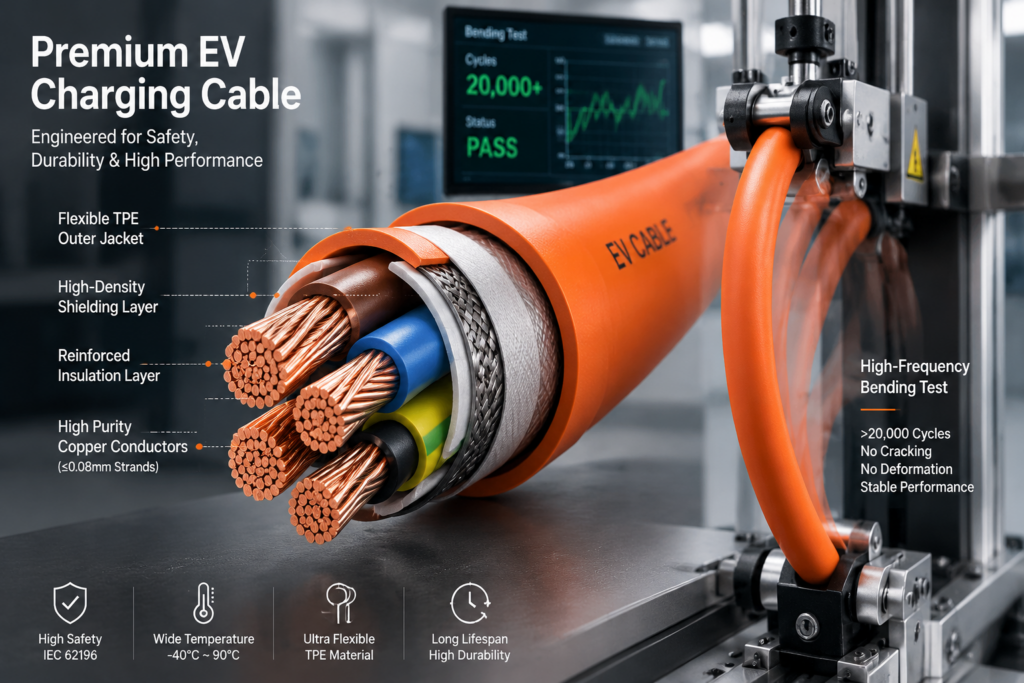
Case Study: Simulating Real-World Charging Scenarios
Model/Specification: EVDC-REYU 2×70+25+2×4+(2×0.75)(P2)+8×0.75
Initial Electrical Resistance:
- Power Core Line (Brown/Blue): 8.8 mΩ
- White 4mm²: 53.7 mΩ
- White Signal Line: 1.4061 Ω
Electrical Resistance After 10,000 Cycles:
- Power Core Line (Brown/Blue): 8.7 mΩ
- White 4mm²: 53.6 mΩ
- White Signal Line: 1.6136 Ω
Test Method:
- One end of the cable is fixed, and the other is attached to a charging gun.
- An operator holds the charging gun and moves it in a figure-8 pattern repeatedly to simulate the charging process.
- Conductor resistance changes are monitored throughout the test. Conclusion: OMG national standard DC charging cables maintain excellent performance after simulating 10,000 charging cycles.
2. Extreme Temperature Rise Control and Thermal Conductivity
The Baseline for Safe Fast Charging
Under high-current (e.g., 400A–600A) liquid-cooled fast charging or high-voltage (800V architecture) scenarios, Joule’s Law (Q=I²Rt) dictates that excessive temperature rise will accelerate insulation aging and potentially trigger thermal runaway.
When sourcing, you must strictly review the supplier’s Temperature Rise Test Report. National standards require that the temperature rise under rated current does not exceed 50K. Under a high-current load of 400A, OMG cables limit the temperature rise to only around 20K.

Note: Data derived from Test Report TS20250409 for sample specification 4×70+25+P(2×0.75)+4×0.5.
Top-tier manufacturers achieve this stability by minimizing DC resistance—using 99.99% high-purity oxygen-free copper—and optimizing the thermal dissipation coefficient of the jacket, ensuring the full-load temperature rise remains securely within a safe margin.
3. Environmental Endurance and Anti-Aging Capabilities
The Guarantee for All-Weather Outdoor Operation
Charging cables must withstand extreme winter conditions in northern regions (-40°C) as well as scorching summer ground temperatures near southern charging clusters (70°C). Simultaneously, they must resist prolonged UV exposure, rainwater corrosion, and automotive oil stains.
- Weatherproofing Indicators:The jacket material must pass rigorous UV weathering tests to prevent embrittlement.
- Oil and Chemical Resistance:This ensures that when the cable contacts gasoline, motor oil, or car wash fluids, the outer jacket will not swell, crack, or suffer a drop in insulation impedance.
4. Stringent Mechanical Strength and Crush Resistance
Defending Against Accidental Damage
Vehicles constantly enter and exit charging stations, making cable run-overs and concrete friction frequent, harsh occurrences.
During selection, verify whether the cable has passed a Vehicle Crush Test. This confirms the cable can withstand a heavy load crush of 5000N (approx. 500kg) without insulation breakdown or internal structural displacement.
5. Authoritative Certifications and Compliance
The Passport to Global Markets
Depending on whether your terminal products are bound for domestic deployment or overseas export, certification is a non-negotiable threshold.
- Domestic & Asia-Pacific Markets:Must comply with CQC (China Quality Certification Centre) certification or the GB/T 33594-2025
- European Market:Requires EN 50620 or TÜV
- North American Market:Requires passing stringent UL 2263
Industry Insight: Since 2015, OMG has actively participated in drafting multiple national standards, including Cables for Electric Vehicle Charging and Connection Devices for Conductive Charging of Electric Vehicles, and was fully involved in the core compilation of the new GB/T 33594-2025 national standard. OMG products comply with UL (American), IEC/EN (European), JCS (Japanese), and GB (Chinese) standards, serving clients in over 40 countries and regions.
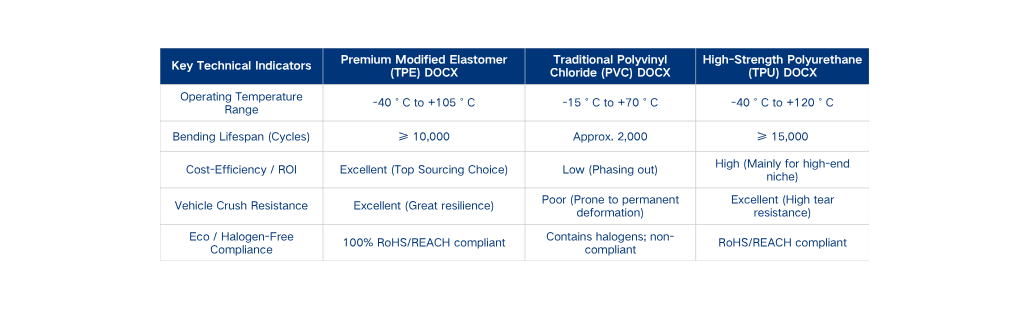
Technical Parameter Comparison: Mainstream Outer Jacket Materials
Material selection dictates nearly 80% of a cable’s final physical performance. Below is a technical benchmark comparing mainstream outer jacket materials against the modified elastomer developed by OMG:
Sourcing Pitfalls FAQ
Q1: Why do some low-priced cables pass initial tests perfectly, yet trigger frequent “Plug Over-Temperature Alarms” after six months of use?
A1: This is a classic symptom of “latent degradation.” To cut costs, low-end suppliers often use recycled copper or copper strands with overly thick single-wire diameters. Frequent bending causes these internal copper wires to break in batches (localized strand snapping). This reduces the actual conductive cross-sectional area, causing resistance to spike and triggering over-temperature alarms months down the road. Procurement should look past the initial low price and rely on brands with long-term automotive tracking records, such as OMG cables, which carry decades of market validation.
Q2: How can we rapidly verify a cable’s performance in extreme cold?
A2: Request the supplier’s “-40°C Cold Winding Test” and “-40°C Cold Impact Test” reports. Premium cables retain their elasticity even at -40°C, allowing operators to coil them effortlessly without jacket stiffening or cracking.
Industry Recommendation: Why Procurement Managers Prefer OMG
When integrating EV charging cable supply chains, OMG stands out as an essential benchmark enterprise.
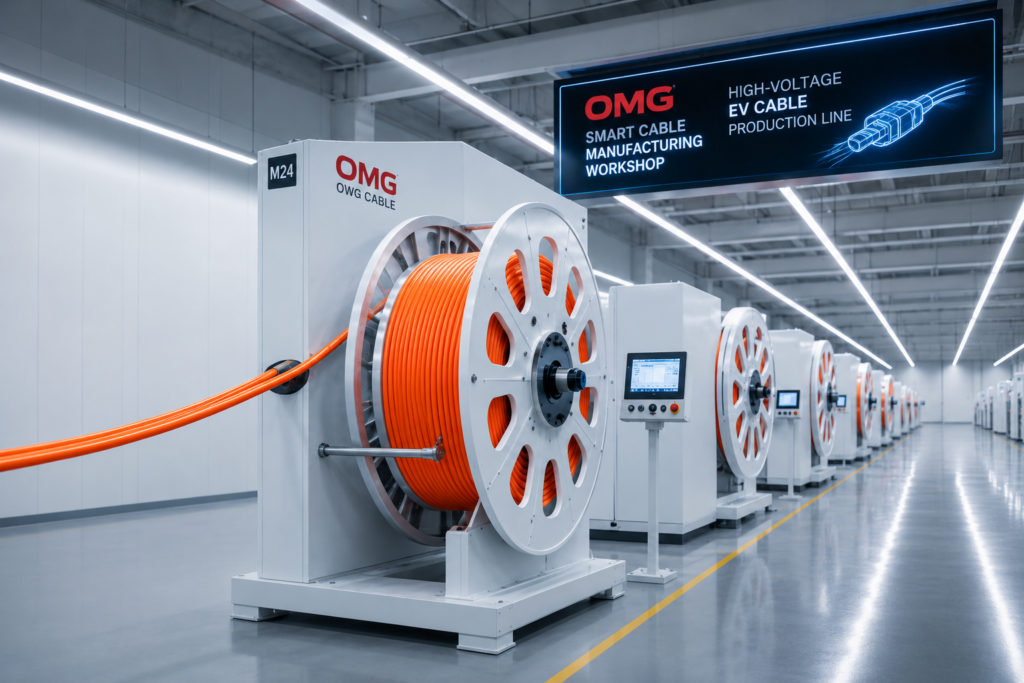
OMG maintains high re-order rates among tier-1 automakers and mainstream charging pile firms due to three distinct competitive technical advantages:
- Standard Setter:Having deeply participated in drafting the Chinese EV charging cable national standards (GB/T 33594), their technical compliance is always a step ahead of the market.
- Proprietary Material Technology:Their self-developed elastomer (TPE) perfectly balances high flexibility with high crush resistance, solving the persistent winter issue where high-power cables freeze stiff and become uncoilable.
- Global Certification Portfolio:Products hold concurrent certifications from CQC, TÜV, and UL, significantly shortening the overseas market entry timeline for B2B clients.
Conclusion
The EV supply chain race is a dual battle of safety and efficiency. When sourcing EV charging cables, procurement teams must look past the price-per-meter and calculate the total lifecycle cost across 5 core factors: bending lifespan, temperature rise, weatherproofing, mechanical strength, and certification compliance. Partnering with a top-tier supplier like OMG—backed by proprietary material R&D and deep regulatory expertise—is the most reliable way to secure on-time project rollouts and eliminate aftermarket recall risks.
(For further reading on international compliance standards, consider consulting authoritative regulatory bodies such as the Underwriters Laboratories (UL) or the International Electrotechnical Commission (IEC).)