

Liquid-Cooled Cables: The Backbone of Megawatt Supercharging Infrastructure
1. Charging Infrastructure: The Universal Demand for Speed Upgrade
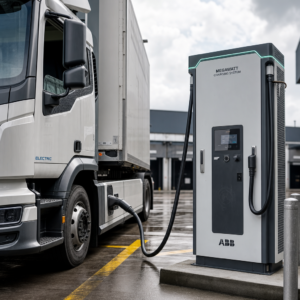
The electric vehicle (EV) charging infrastructure is undergoing a profound efficiency transformation. At public charging hubs, end-users increasingly expect a “refueling-like” charging experience. In heavy-duty logistics and mining sectors, demanding operational schedules necessitate drastically reduced downtime for energy replenishment. For instance, megawatt-level liquid-cooled charging systems—such as 1.44 MW deployments—can charge a 300 kWh heavy-duty truck battery to 90% in just 15 minutes. In the maritime sector, newly built and retrofitted ports now mandate high-power shore-to-ship charging systems. Furthermore, off-highway machinery, including electric loaders and mining dump trucks, faces an urgent demand for high-current, rapid energy replenishment.
The global market for liquid-cooled EV charging cables is projected to grow from $580 million in 2025 to $1.9 billion by 2035, representing a compound annual growth rate (CAGR) of 13%. As the era of ultra-fast charging dawns, megawatt-level charging is transitioning rapidly from R&D laboratories to full-scale commercial deployment.
2. Technical Bottlenecks: Thermal Management as the Core Challenge
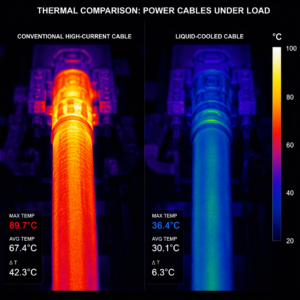
The primary bottleneck in achieving ultra-fast charging lies in heat dissipation. As charging current increases, Joule heating (I²R) in the conductor escalates quadratically. Traditional passive cooling mechanisms cannot dissipate this intense thermal load effectively unless the conductor cross-sectional area is drastically increased. However, larger conductors lead to excessively heavy and stiff cables, hindering daily operation.
This physical limit makes liquid cooling the essential technical pathway. The fundamental principle involves integrating internal coolant channels into the cable structure, using forced fluid circulation to actively remove heat rather than relying on passive ambient dissipation.
Engineers face three interconnected engineering trade-offs:
|
Challenge |
Specific Description |
Engineering Consequence |
|
Current vs. Heat Generation |
Higher current elevates resistive heat losses, pushing conductor temperatures beyond safe insulation limits (typically >90°C). |
Limits maximum continuous power output; accelerates thermal degradation of insulation materials. |
|
Current vs. Cable Weight |
Increasing copper conductor size to lower resistance results in excessive cable mass. |
Poor ergonomics, severe operator fatigue, and difficulty in manual handling. |
|
Long-Term Reliability |
Localized hotspots and thermal cycling stress coolant hoses and sealing interfaces. |
Risk of coolant leakage, hose burst, and shortened cable operational lifespan. |
3. OMG Liquid-Cooled Cable Solutions: Overcoming Engineering Bottlenecks
OMG’ (Guangdong OMG Transmitting Technology Co., Ltd.) has specialized in the R&D and manufacturing of EV conductive products since 2009. The latest liquid-cooled cable series addresses these engineering challenges through structural optimization and rigorous qualification testing:
3.1 High Ampacity Without Hose Burst Risks: Thermal Management & Safety
OMG liquid-cooled cables feature built-in coolant channels that recirculate specialized dielectric fluids, keeping conductor temperature rise minimal under heavy electrical load. The product line supports continuous current ratings from 400A to 1000A, with peak power capabilities up to 1500A—covering applications from public fast chargers to heavy-duty megawatt stations.
Safety is engineered into the fluid channel architecture: the internal cooling hoses withstand burst pressures exceeding 15 bar, far higher than standard operating requirements. The complete cable assembly passes vehicle run-over tests, ensuring mechanical durability under harsh field conditions.
3.2 30% Smaller Outer Diameter, 50% Weight Reduction: Superior Ergonomics
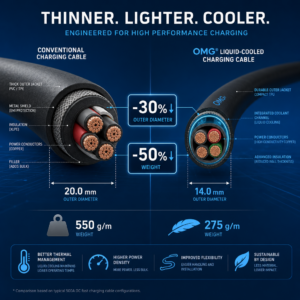
By combining active liquid cooling with optimized conductor geometry, OMG achieves a 30% reduction in outer diameter and a 50% reduction in overall cable weight compared to conventional passively cooled equivalents. This design eliminates the bulky “dumbbell” feel of high-power cables, allowing station operators to handle the connector gun effortlessly with one hand and significantly reducing fatigue in fleet charge yards.
3.3 Exceptional Temperature Rise Control: Maximizing Efficiency and Lifespan
The active fluid loop maintains conductor temperatures below 75°C during continuous high-current transmission. Suppressing temperature rise keeps conductor resistance lower (improving charging power transfer efficiency) and mitigates thermal stress on surrounding polymer insulation, extending operational longevity and lowering Total Cost of Ownership (TCO) for Charge Point Operators (CPOs).
Key Performance Parameter Comparison
|
Performance Metric |
OMG Liquid-Cooled Cable |
Conventional Passively Cooled Cable |
|
Continuous Ampacity |
400A – 1000A (Peak up to 1500A) |
≤250A (Requires massive cross-section) |
|
Outer Diameter (Relative) |
70% of conventional cable |
100% |
|
Total Weight (Relative) |
50% of conventional cable |
100% |
|
Max Conductor Temp |
≤75°C |
Typically > 90°C |
|
Hose Burst Pressure |
> 15 bar |
N/A (No liquid cooling) |
3.4 Comprehensive Global Regulatory Compliance
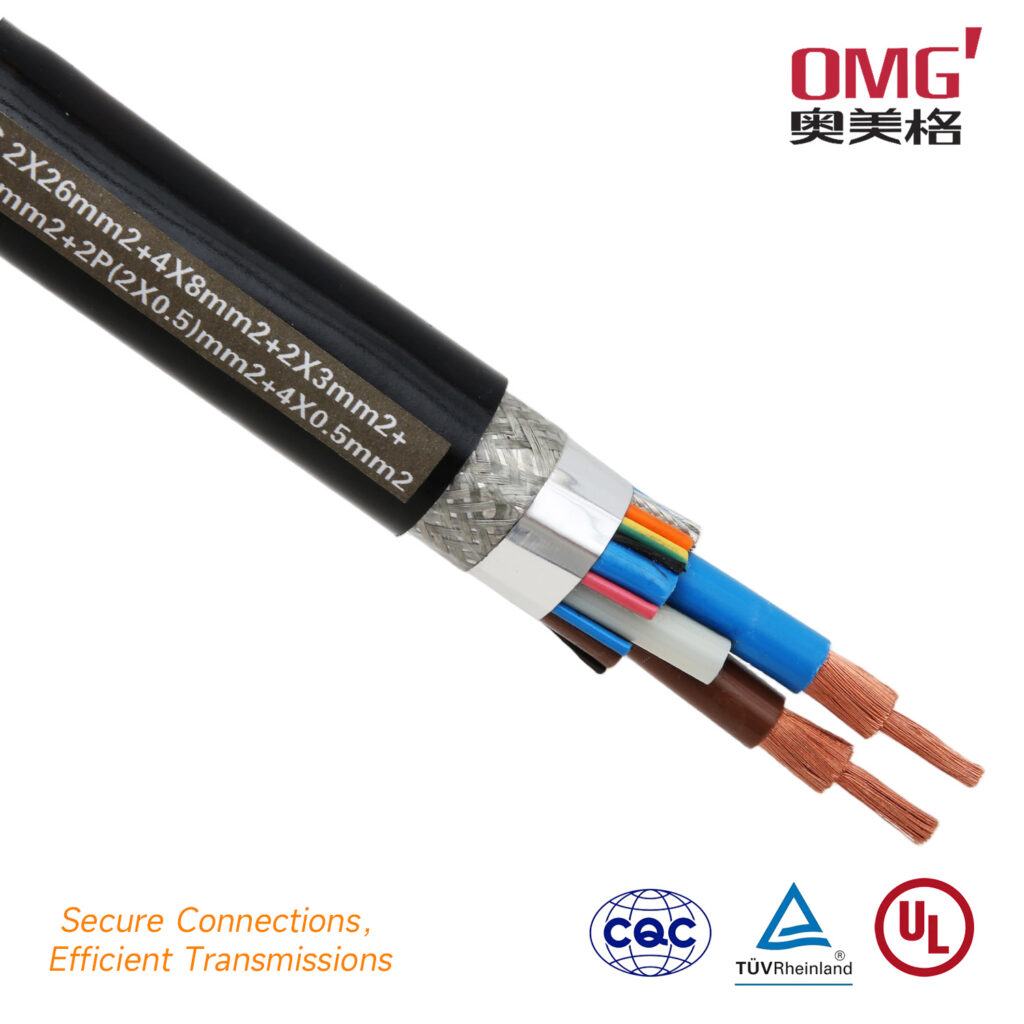
OMG liquid-cooled cables hold complete global certifications, enabling smooth compliance and entry into North American, European, and Asia-Pacific markets:
|
Standard |
Target Region / Market |
Compliance Status |
|
UL 2263 |
North America (USA / Canada) |
✅ Certified |
|
IEC 62893-4-2 |
Europe & International |
✅ Certified |
|
GB/T 33594-2025 |
China |
✅ Certified |
|
CQC 1147-2025 |
CQC Quality Certification |
✅ Certified |
OMG is among the earliest manufacturers in China to achieve full UL EVE/EVJE series certification and serves as a drafting committee member for updated GB/T and CQC charging cable standards. All materials comply strictly with environmental regulations including RoHS 2.0 and REACH.
3.5 Full Product Portfolio & Custom Engineering Services
OMG offers comprehensive liquid-cooling technical routes, including oil-cooled (immersed/direct) and water-cooled (isolated/copper-wrapped) architectures. Engineering teams provide customized hydraulic circuit design and thermal simulation modeling tailored to specific client power profiles:
- Public Supercharging Stations:400A–600A cable assemblies balancing ampacity, ergonomics, and cost efficiency.
- Heavy Trucks & Mining Fleets:600A–1000A high-ampacity solutions built for 1.5 MW megawatt charging requirements.
- E-Vessels & Shore-to-Ship Power:High-power, durable custom cables designed for harsh marine environments.
- Off-Highway Heavy Machinery:Reinforced outer jacketing offering abrasion and drag resistance.
3.6 Lightweight Handling and Eco-Friendly Materials
Constructed with oxygen-free high-conductivity copper and high-grade Thermoplastic Polyurethane (TPU) outer jacketing, OMG cables offer flexibility, oil resistance, and mechanical toughness. Full compliance with RoHS 2.0 and REACH standards supports sustainable green manufacturing practices.
4. Industry Outlook: Moving Toward Intelligent Megawatt Charging
As megawatt charging (MCS) and 4C/6C ultra-fast battery chemistry adoption accelerates, liquid-cooled cable assemblies will become standard infrastructure components. Future technological developments focus on higher current density, lighter flexible materials, and integrated diagnostic monitoring sensors.
Having contributed to the revision of China’s GB/T 2025 charging cable standards and deployed liquid-cooled solutions across heavy-truck charging hubs and port power projects globally, OMG continues to advance conductive thermal management technology.
External References & Industry Standards
UL Standards: UL 2263 Standard for Electric Vehicle Cables
IEC Standards: IEC 62893 Charging Cables for Electric Vehicles
China Quality Certification Center: CQC & GB/T Certification Portal
OMG Technical Portfolio: OMG Oil-Cooled Charging Cable Technical Specs